Is it even possible?
It is not easy to walk in someone's shoes. Neither is to think like someone else but in 2005 in my workshop, 'Inspired by the quilts of Gee's bend' my students and I did just that. I challenged them to make something by re-purposing old clothes that no one wanted. While some students had hard time investing their time is something ugly and old, I decided I will stick to the original plan. I made a trip to our local Goodwill store and bought few clothes.
My rules:
The idea was to experience what women of Gee's bend would while making a quilt. I tried all of the above elements along with my students.. I made the top by using old, overly worn-out corduroy which felt like a card-board and men's shirts made with blend, rayon and cottons. I tossed in strips of my husband's shirts and my dress to emotionally connect with the piece.

We chose to make the housetop blocks to avoid trimming and wasting as little as possible. To waste pieces of fabrics was not an option. I had also set the limit on how much of each garment we could use and use every last piece to make the most out of what we had.
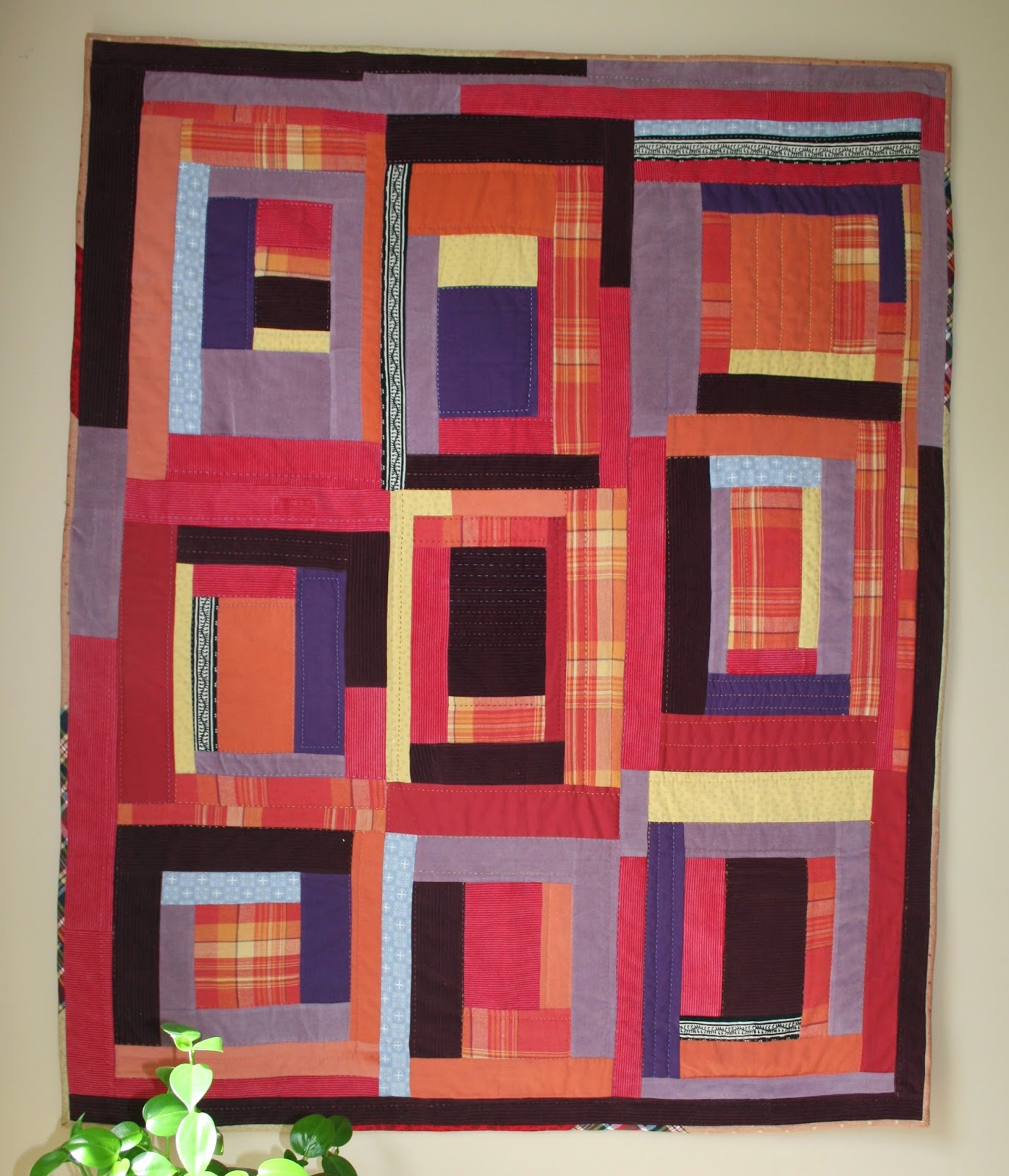
I ended up with this top. I thought I had achieved my goal really well. I made a quilt top that looked similar to the one in the book. I felt pretty proud of myself for attempting to understand them or to be in the similar mindset of the quilters of Gee's bend.
I thought I understood it completely but not quite. I spent last couple of weeks hand quilting this old top. It was part of my slide show presentation in Ithaca but I wanted to carry it with me as a finished quilt to my next presentation.
The process of hand quilting turned out to be phase two of getting in the mindset of the quilters of Alabama.
My thought process went something like this -
What if winter was approaching and I had nothing to keep us warm?
I would finish that quilt in a hurry!
Would I worry about the perfection in my stitching?
No time to think about that in low light and late in the night after all day's work.
Would I spend time undoing so they all look perfect?
It was going on a bed not in a show or on a wall in a gallery.
Would I have time to find a quilting pattern suitable to the quilt?
I see plenty patterns all around me to follow.
Would I run to the nearest store that was miles away to find the thread I just ran out while I was in the middle of quilting it?
No.. No!

I would just stitch away at the end of the day, every chance I get, with any thread I had in my box.. I would just finish the quilt.
My theory on all this is - Learn many things by just doing it.
Here is what I experienced.
Having various materials on the same quilt, my stitches varied all through out. It was so hard to hand quilt that beaten up, old cardboard like corduroy material. I could get somewhat perfect stitching on the finer fabrics like my husband's shirt and my dress but some corduroy with spandex was difficult to needle through.
I do understand those quilters now. The feel of the quilt varies from block to block and it is the warmest and heaviest quilt in the stack of wall quilts.

In spite of tearing the trips on the grain, they stretched every which way according to their fiber contents.I left the edges as they were and used binding on bias to finish the quilt.
The last thing remained was to see what it would look like if it were to hang on the clothesline in one of the southern states. So I went out this morning and took few pictures.

It's rugged and cozy quilt. If I were to machine quilt this one, it would have broken a few needles.

I was pretty happy that the quilt was ready in time for my presentation at Calico Cutters Guild last Wednesday. It was the guild's first event at the new location in West Chester, PA and what a great experience for me as well. Thank you, Calico Cutters Guild members who made it out there to listen to my talk and see the quilts.

Thank you for reading this post!
Sujata
It is not easy to walk in someone's shoes. Neither is to think like someone else but in 2005 in my workshop, 'Inspired by the quilts of Gee's bend' my students and I did just that. I challenged them to make something by re-purposing old clothes that no one wanted. While some students had hard time investing their time is something ugly and old, I decided I will stick to the original plan. I made a trip to our local Goodwill store and bought few clothes.
My rules:
- tear the clothes - not cut
- sew without a specific seam allowance
- when needed use scissors instead of rotary cutter
- incorporate materials varying in thickness and fabric content
- stick to a limited number of clothes to mimic the 'make do' ways of quilting to achieve simple, bold and graphic quilts.
The idea was to experience what women of Gee's bend would while making a quilt. I tried all of the above elements along with my students.. I made the top by using old, overly worn-out corduroy which felt like a card-board and men's shirts made with blend, rayon and cottons. I tossed in strips of my husband's shirts and my dress to emotionally connect with the piece.

We chose to make the housetop blocks to avoid trimming and wasting as little as possible. To waste pieces of fabrics was not an option. I had also set the limit on how much of each garment we could use and use every last piece to make the most out of what we had.
I ended up with this top. I thought I had achieved my goal really well. I made a quilt top that looked similar to the one in the book. I felt pretty proud of myself for attempting to understand them or to be in the similar mindset of the quilters of Gee's bend.
I thought I understood it completely but not quite. I spent last couple of weeks hand quilting this old top. It was part of my slide show presentation in Ithaca but I wanted to carry it with me as a finished quilt to my next presentation.
The process of hand quilting turned out to be phase two of getting in the mindset of the quilters of Alabama.
My thought process went something like this -
What if winter was approaching and I had nothing to keep us warm?
I would finish that quilt in a hurry!
Would I worry about the perfection in my stitching?
No time to think about that in low light and late in the night after all day's work.
Would I spend time undoing so they all look perfect?
It was going on a bed not in a show or on a wall in a gallery.
Would I have time to find a quilting pattern suitable to the quilt?
I see plenty patterns all around me to follow.
Would I run to the nearest store that was miles away to find the thread I just ran out while I was in the middle of quilting it?
No.. No!
I would just stitch away at the end of the day, every chance I get, with any thread I had in my box.. I would just finish the quilt.
My theory on all this is - Learn many things by just doing it.
Here is what I experienced.
Having various materials on the same quilt, my stitches varied all through out. It was so hard to hand quilt that beaten up, old cardboard like corduroy material. I could get somewhat perfect stitching on the finer fabrics like my husband's shirt and my dress but some corduroy with spandex was difficult to needle through.
I do understand those quilters now. The feel of the quilt varies from block to block and it is the warmest and heaviest quilt in the stack of wall quilts.

In spite of tearing the trips on the grain, they stretched every which way according to their fiber contents.I left the edges as they were and used binding on bias to finish the quilt.
The last thing remained was to see what it would look like if it were to hang on the clothesline in one of the southern states. So I went out this morning and took few pictures.

It's rugged and cozy quilt. If I were to machine quilt this one, it would have broken a few needles.

I was pretty happy that the quilt was ready in time for my presentation at Calico Cutters Guild last Wednesday. It was the guild's first event at the new location in West Chester, PA and what a great experience for me as well. Thank you, Calico Cutters Guild members who made it out there to listen to my talk and see the quilts.

Thank you for reading this post!
Sujata